

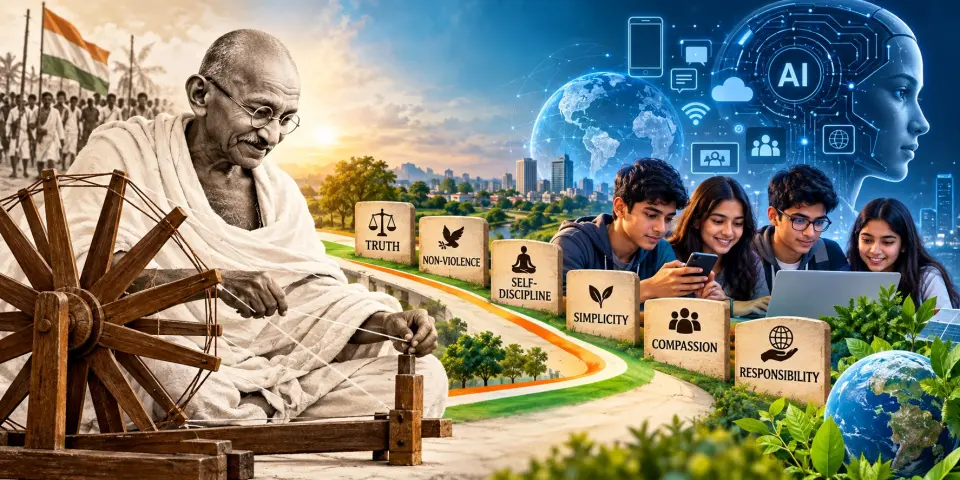
Every year, 2 October reminds us of Mahatma Gandhi. Schools organise programmes, students deliver speeches, cleanliness drives are conducted and tributes are paid to one of the most recognised leaders of India's freedom struggle. But beyond the portraits, statues and ceremonies, an important question remains: What does Gandhi's message mean to us in the world of smartphones, social media and artificial intelligence?
Mohandas Karamchand Gandhi was born on 2 October 1869 at Porbandar in Gujarat. Through his life and work, he became closely associated with truth, non-violence, Satyagraha, simplicity, self-discipline and service to society. His methods played an important role in India's freedom struggle and influenced movements for justice and civil rights around the world.
More than seven decades after India's independence, the world has changed dramatically. We have smartphones instead of letters, social media instead of many traditional forms of communication, artificial intelligence assisting us with tasks once performed only by humans, and instant access to information from almost every corner of the world.
Yet some human values have not changed. We still need truth. We still need compassion. We still need self-discipline. We still need the ability to disagree without hatred. In this sense, Gandhi's message continues to speak to the present generation.
Gandhi placed truth at the centre of his life. As he famously said, “Truth is God.” Today, truth faces a new challenge. Information can travel across the world in seconds. A message can be forwarded to hundreds of people with one click. Artificial intelligence can create realistic images, videos, voices and written content. Social media has made communication easier, but it has also made it easier for false or misleading information to spread.
This makes the responsibility of every digital citizen much greater.
Before believing a message, we should check it. Before forwarding information, we should verify it. Before sharing a photograph or video, we should ask whether it is genuine and whether sharing it could harm another person.
In today's world, Gandhi's idea of truth can therefore be understood not only as a personal virtue but also as a responsibility in the digital space.
His principle of Ahimsa, or non-violence, is equally relevant. Gandhi is widely associated with the observation, “An eye for an eye only ends up making the whole world blind.” Violence is not always physical. Words can also hurt. Bullying, insulting, threatening, spreading rumours and deliberately humiliating someone can cause deep harm.
Social media has given everyone a voice, but having a voice also brings responsibility. We may disagree with someone's opinion, but disagreement does not give us the right to insult or threaten that person.
Gandhi's approach reminds us that it is possible to oppose an idea without hating the person who holds it. For young people growing up in an increasingly connected world, this is a valuable lesson.
Gandhi also emphasised self-discipline. This idea has become especially important in an age of smartphones, online entertainment and constant notifications.
Technology is a powerful tool. It can help students learn, teachers teach, researchers discover and people communicate. But when technology begins to control our time and attention, the tool can become a distraction.
The important question is not whether technology is good or bad. The question is whether we are using technology wisely.
The same applies to artificial intelligence. AI can help students understand difficult concepts, generate ideas, conduct research and explore new possibilities. But it should not replace curiosity, independent thinking or genuine effort.
A student who uses AI to learn is using technology as a tool. A student who uses it simply to avoid thinking may be losing an opportunity to learn.
Gandhi's simple lifestyle also offers an important lesson for today's consumer-driven world. We are often encouraged to measure success through the things we own—expensive phones, clothes, cars and other possessions.
There is nothing wrong with progress or comfort. But we should also understand the difference between our needs and unnecessary wants.
Saving water, reducing waste, avoiding unnecessary plastic, reusing resources and respecting nature are simple forms of responsible living. Gandhi's emphasis on simplicity can therefore be connected with today's growing concern for the environment. His often-quoted observation that the Earth provides enough for our needs, but not for our greed, remains a powerful reminder of responsible consumption.
His ideas are equally relevant to education.
Education is not simply about marks, examinations and degrees. A truly educated person should also know how to think, how to behave, how to respect others and how to take responsibility.
A student may achieve excellent marks, but if he or she cheats, bullies others, spreads false information or refuses to help people in need, something important is still missing.
Education should develop both the mind and the character.
As teachers, we have a responsibility to help young people become not only successful professionals but also responsible citizens. Students should be encouraged to ask questions, think critically, respect different opinions and use their knowledge for the benefit of society.
At the same time, remembering Gandhi should not mean placing him beyond questions or discussion. Historical figures should be studied in their full context. Gandhi had agreements and disagreements with many contemporary leaders, and India's freedom struggle involved numerous leaders, movements, ideas and sacrifices.
A mature understanding of history allows us to appreciate contributions while also examining different perspectives. Respecting a historical figure and thinking critically about his ideas can go together.
Perhaps Gandhi's greatest relevance today lies in the questions his life continues to ask us.
Can we speak the truth when lying seems easier?
Can we disagree without hatred?
Can we use technology without becoming controlled by it?
Can we use artificial intelligence without losing our ability to think independently?
Can we stand against injustice without becoming unjust ourselves?
Can we consume responsibly and protect nature?
Can our education make us not only knowledgeable but also compassionate and responsible?
These questions make Gandhi relevant even in the 21st century.
On Gandhi Jayanti, therefore, perhaps we should do more than remember Gandhi through speeches, photographs and ceremonies. We can choose one value from his life and try to practise it.
We can speak the truth. We can verify information before sharing it. We can refuse to participate in cyberbullying. We can respect people with different opinions. We can keep our surroundings clean. We can save water and reduce waste. We can use technology responsibly. We can help others without expecting anything in return.
Great changes do not always begin with great actions. Sometimes they begin with one person making a small but sincere change in his or her own behaviour.
The journey from Gandhi's spinning wheel to today's smartphone may seem enormous, yet the human values that matter have changed very little. The charkha represented self-reliance, dignity of labour and disciplined effort; the smartphone represents connectivity, speed and technological power. The real challenge before our generation is to ensure that our technological progress does not come at the cost of our humanity.
On this Gandhi Jayanti, therefore, the most meaningful tribute to Gandhi may not be another garland, speech or ceremony. It may be a decision to speak the truth when it is difficult, to disagree without hatred, to use technology responsibly, to protect nature, to respect human dignity and to serve others without expecting recognition.
Gandhi belongs to history, but his questions belong to the present. The world may have moved from the charkha to artificial intelligence, but the need for truth, compassion and conscience remains unchanged. Remembering Gandhi, therefore, is not merely about looking back at the past; it is about deciding what kind of future we want to build.