

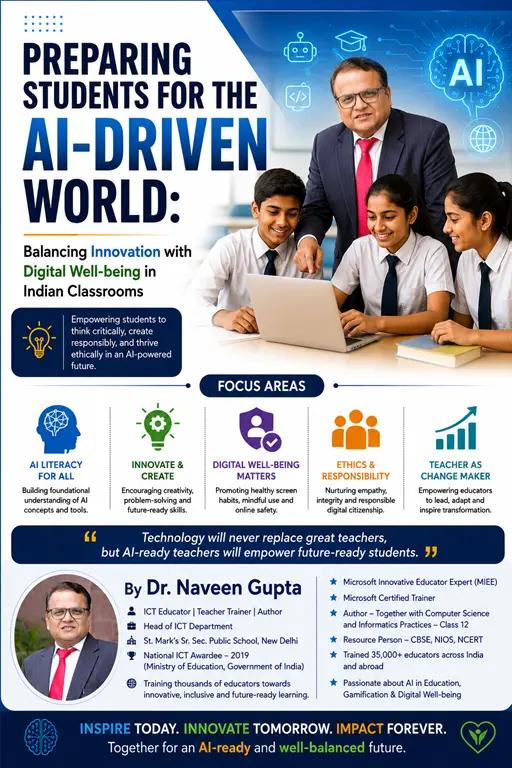
Introduction
Artificial Intelligence is no longer a distant future technology—it is reshaping education today. From personalized learning platforms to intelligent tutoring systems, AI is transforming how students learn and how educators teach. However, as we embrace AI's potential, we face a critical challenge: How do we prepare our students to thrive in an AI-driven world while safeguarding their digital well-being?
This article explores the intersection of AI literacy and digital well-being in Indian classrooms. Drawing from my experience training over 350,000 educators and learners across India, I argue that AI education must be coupled with intentional strategies to protect students' mental health, foster responsible technology use, and develop the critical thinking skills they need to navigate an increasingly complex digital landscape.
The AI Literacy Imperative: Why Indian Schools Must Act Now
AI literacy, the ability to understand, interact with, and critically evaluate AI systems—is no longer optional. It is a fundamental 21st-century skill.
India's National Education Policy 2020 recognizes this imperative, emphasizing critical thinking, computational thinking, and responsible technology integration. Yet, many schools struggle to translate this vision into practice. Educators report feeling unprepared to teach about AI; students are using AI tools without understanding their limitations; and the ethical dimensions of AI adoption remain underexplored in most Indian classrooms.
Consider this scenario: A student uses ChatGPT to complete their homework assignment without understanding how the AI generated the response. They may receive full marks, but they've missed the opportunity to develop critical thinking. Worse, they may not recognize that AI-generated content can contain biases, inaccuracies, or plagiarized material. This is precisely where AI literacy becomes essential—not just to understanding what AI can do, but also understanding its limitations, ethical implications, and societal impact.
In Indian classrooms, where access to technology varies widely, the challenge is even more pressing. Schools in urban centers may have AI tools and coding labs, while rural schools struggle with basic internet connectivity. Yet, regardless of resources, every student deserves an education that prepares them to live, work, and make decisions in an AI-influenced world.
The Digital Well-being Crisis: Understanding the Stakes
As we increase technology integration, we must acknowledge a troubling reality: digital well-being among Indian students is declining. Mental health professionals report rising cases of:
• Smartphone and social media addiction, particularly among adolescents
• Cyberbullying and online harassment affecting academic performance and self-esteem
• Sleep disruption and anxiety linked to excessive screen time
• Misinformation consumption and the inability to distinguish reliable from unreliable sources
The irony is painful: as we advocate for digital literacy and technology-enabled learning, our students are experiencing unprecedented digital stress. This creates a paradox that educators must address thoughtfully. We cannot simply add more technology to the curriculum without simultaneously teaching students how to use it responsibly and maintain their well-being.
A Framework for Integration: Merging AI Literacy with Digital Well-being
Effective AI education in Indian schools requires a holistic framework that interweaves AI literacy with digital citizenship, media literacy, and digital well-being. This framework rests on five pillars:
1. Demystifying AI: From Magic to Mechanism
Many students view AI as mysterious, all-knowing, or even magical. Effective AI literacy begins by demystifying these assumptions. Teachers should help students understand that AI systems are created by humans, trained on data, and reflect the biases and limitations of their training data.
Practical classroom activity: Have students examine AI-generated images or text and identify errors, inconsistencies, or biases. Ask them: 'How do you think this AI learned to generate this output? What data might it have been trained on? What limitations might it have?' This builds critical thinking while making AI tangible.
2. Ethical AI: Asking the Right Questions
AI ethics is not a specialized topic for computer scientists—it is foundational for all students. Educators should consistently help students ask ethical questions: Who benefits from this AI system? Who might be harmed? Are there biases in the data or algorithms? How is my personal data being used?
These questions equip students not just to consume AI but to advocate for responsible AI development. In the Indian context, where concerns about data privacy, algorithmic discrimination, and technology's impact on marginalized communities are particularly salient, this ethical foundation is essential.
3. Responsible Tool Use: Beyond Prohibition
Rather than banning AI tools like ChatGPT or recommender systems, educators should teach responsible use. What does this look like?
• Students learn to use AI as a thinking partner, not a replacement for thinking
• They cite AI-generated content and understand plagiarism in the age of generative AI
• They practice discernment: when is AI appropriate to use, and when should they rely on their own knowledge?
• They set healthy boundaries around technology use, recognizing when 'always on' productivity becomes counterproductive
4. Digital Well-being Practices: Integrating Mindfulness and Reflection
Alongside AI and digital literacy, schools must explicitly teach digital well-being practices. This includes:
• Screen time awareness and management strategies
• Recognizing and responding to cyberbullying
• Critical evaluation of online content and sources
• Digital citizenship: understanding rights, responsibilities, and ethical online behavior
Practical example: Students conduct a personal 'digital audit,' tracking their screen time, social media usage, and emotional responses. They then set realistic, sustainable goals for healthy digital habits. This reflective practice builds agency and self-awareness.
5. Community Engagement: Bringing Families and Educators Into the Conversation
AI literacy and digital well-being cannot be isolated to the classroom. Schools must engage families and communities. Parent awareness programmes should help families understand AI's benefits and risks, discuss healthy technology use at home, and support their children's digital citizenship journey.
Teacher professional development is equally critical. Many educators lack confidence in teaching about AI or feel unprepared to address digital well-being challenges. Schools should provide ongoing training, support peer learning communities, and create safe spaces for educators to develop these competencies together.
Practical Implementation in Indian Classrooms
How can Indian schools translate this framework into reality? Here are concrete, scalable strategies:
Strategy 1: Integrate AI Across the Curriculum
AI literacy should not be confined to computer science classes. Mathematics teachers can discuss the algorithms behind recommendation systems. Science teachers can explore AI applications in medical diagnosis. Social studies teachers can examine AI's societal impact. This cross-curricular approach makes AI relevant and demonstrates its ubiquity.
Strategy 2: Use Storytelling and Project-Based Learning
Stories are powerful teaching tools. Share narratives of AI's positive applications (agricultural AI helping farmers optimize crop yields) alongside cautionary tales (algorithmic discrimination in hiring systems). Project-based learning—such as students creating awareness campaigns about AI bias or developing responsible AI use policies for their school—builds agency and deeper understanding.
Strategy 3: Establish Digital Citizenship Clubs
Student-led clubs focused on digital citizenship, media literacy, and responsible AI use can amplify the impact of classroom learning. These clubs can create school-wide awareness campaigns, peer mentor younger students, and become changemakers in their communities.
Strategy 4: Develop Parent Engagement Programs
Host workshops for parents on understanding AI, recognizing signs of digital stress in their children, and fostering healthy technology habits at home. These conversations build partnerships between schools and families, essential in the Indian context where parental support is pivotal to student success.
Strategy 5: Create Professional Learning Communities for Educators
Support teachers through ongoing professional development, peer learning, resource sharing, and collaborative curriculum design. Educators are more confident and effective when they learn together and feel supported in this evolving landscape.
Addressing Challenges: The Indian Context
Implementing this framework in Indian schools faces distinct challenges that must be acknowledged and addressed:
Challenge: Varying Access and Digital Divide
Solution: Schools without advanced technology should focus on conceptual understanding, ethics, and critical thinking about AI rather than hands-on coding. Case studies, discussions, and storytelling are powerful tools that don't require expensive resources. Additionally, leverage free, open-source tools and platforms where possible.
Challenge: Educator Preparedness
Solution: Invest in comprehensive teacher training programs. Partner with teacher training institutes, educational NGOs, and technology companies to provide accessible professional development. Create peer mentoring networks where early adopters support colleagues.
Challenge: Curriculum Integration
Solution: Work with educational boards and curriculum designers to incorporate AI and digital well-being into existing frameworks. This doesn't require overhauling curricula—rather, thoughtful integration of relevant examples and concepts within existing subjects.
Conclusion: Preparing Future-Ready Learners
The challenge before Indian educators is not whether to teach about AI—it is how to do so in ways that empower rather than overwhelm our students. We must prepare young people who are not passive consumers of AI technology but informed, ethical, resilient participants in an AI-shaped world.
This begins with a commitment to integrating AI literacy and digital well-being. It requires educators who are equipped, supported, and empowered. It demands engagement with families and communities. And it necessitates policies and resources that reflect the reality of Indian schools—diverse, resourceful, and determined to give every student the education they deserve.
As I reflect on my years training educators across India, I am convinced of one truth: when teachers believe that their students deserve better, they find ways to make it happen. The path to preparing students for the AI-driven world is not easy, but it is essential. Let us walk it together—with purpose, compassion, and unwavering commitment to our students' growth and well-being.
About the Author: An ICT educator with 20+ years of experience, the author has trained approximately 350,000 educators and learners across India through workshops, conferences, and professional development programs. Currently, the Head of the ICT Department at St. Mark's Sr. Sec. Public School, New Delhi, and a Resource Person for the Central Board of Secondary Education Centre of Excellence (Delhi West), the author specializes in Artificial Intelligence in Education, Digital Citizenship, Cyber Safety, and responsible technology integration.