
Education has long been recognized as the most powerful instrument of social transformation. Yet in Jammu and Kashmir, geography silently shaped the destiny of thousands of learners. In the mountainous and remote regions of our Union Territory, limited access to quality resources, scarcity of subject experts, and minimal exposure to modern learning tools once constrained academic growth.
Over the past few years, however, Information and Communication Technology (ICT) has begun to rewrite this narrative. What once seemed distant and aspirational is now steadily becoming a lived classroom reality.
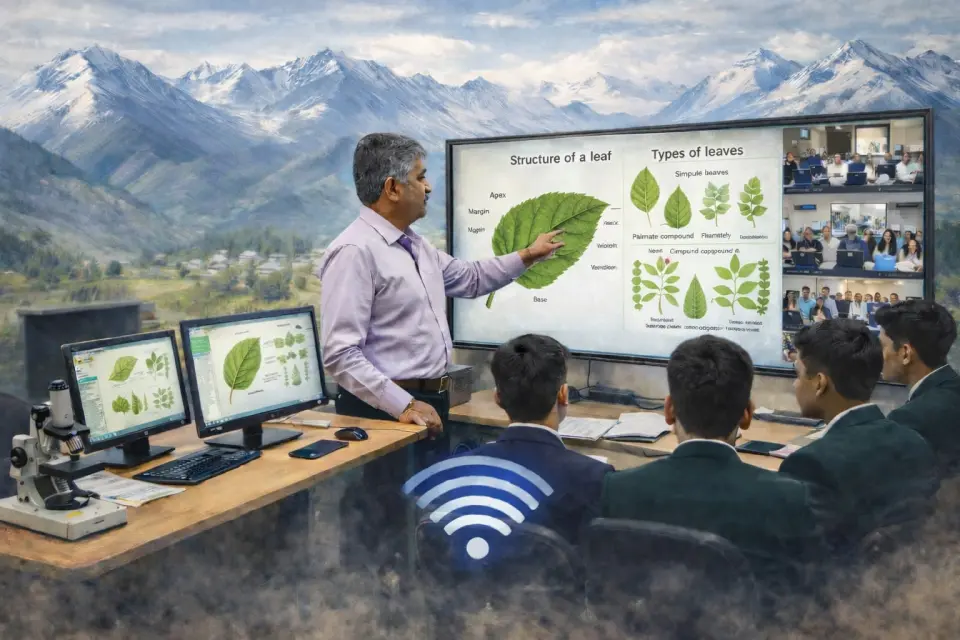
The integration of ICT has fundamentally reshaped the teaching - learning process. Classrooms are no longer confined to textbooks and chalkboards. Digital simulations, animations, virtual laboratories, multimedia presentations, and interactive content have transformed lessons into engaging experiences. Scientific concepts that once appeared abstract are now visualized with clarity. Students explore ideas beyond the four walls of their classrooms, nurturing curiosity, critical thinking, and deeper understanding.
National institutions have played a pivotal role in this transformation. The National Council of Educational Research and Training (NCERT), through its constituent body CIET, New Delhi, has developed structured, curriculum-aligned digital content and platforms such as DIKSHA and PM eVIDYA. These initiatives have ensured that both teachers and students have access to credible, high - quality digital resources. During challenging times, including periods of disruption, these platforms sustained academic continuity and reinforced the culture of digital learning.
At the regional level, SCERT Jammu and Kashmir has effectively contextualized national initiatives to suit local needs. By designing digital modules, organizing professional development programmes, and guiding teachers in ICT integration, SCERT has strengthened the ecosystem of digital education. District Institutes of Education and Training (DIETs) have further empowered educators at the grassroots through workshops, mentoring, and hands-on ICT training. Through my own engagement in teacher training and ICT initiatives, I have witnessed how even teachers in remote schools have gradually embraced digital tools with confidence and creativity.
A major milestone in this journey has been the establishment of ICT Labs, CAL Labs, and Smart Classrooms under the Samagra Shiksha initiative. Across Jammu and Kashmir, 1588 ICT labs, 1420 CAL labs, and 1552 Smart Classrooms have been set up in government schools. These facilities have opened doors to digital literacy and technological competence for thousands of students. Children who once had limited exposure to computers now confidently navigate digital platforms, access educational resources, and prepare themselves for a technology-driven future.
One of the most impactful interventions has been undertaken by the Directorate of School Education Jammu. By leveraging virtual platforms, DSEJ has provided online academic support to schools facing shortages of subject expert teachers. Through this initiative, services of experienced educators from different fields are utilised to deliver lectures and guidance in subjects such as Physics, Chemistry, Mathematics, Biology, and the Humanities to students in remote and underserved areas. This innovative approach has ensured that geographical isolation does not translate into academic disadvantage. It demonstrates how technology can optimize human resources and promote equity in education.
Beyond infrastructure and access, ICT has enhanced professional efficiency. Teachers now utilize digital assessment tools, online resources, and collaborative platforms to refine their pedagogical practices. Administrative processes - record maintenance, progress tracking, communication with parents - have become more streamlined, allowing educators to focus more meaningfully on teaching and mentoring.
The student experience has equally evolved. Learning has become interactive, inclusive, and student-centered. Digital tools encourage independent exploration, strengthen engagement, and improve academic outcomes. More importantly, students are acquiring essential digital skills - skills that are indispensable in higher education, employment, and civic participation in an increasingly digital society.
Certainly, challenges persist. Reliable internet connectivity in remote areas remains uneven. Infrastructure maintenance, technical support, and continuous professional development are crucial for sustainability. There is also a growing need to create more localized digital content aligned with regional languages and contexts. However, these challenges are not deterrents; they are milestones in an ongoing transformation.
The collective efforts of NCERT-CIET, SCERT, DIETs, Samagra Shiksha, and the Directorate of School Education have laid a strong foundation for a digitally empowered education system in Jammu and Kashmir. What is unfolding is not merely a technological shift but a systemic and human transformation.
As an educator serving in a rural setting, I have witnessed this change firsthand. I have seen hesitant learners become confident digital explorers. I have seen teachers transition from traditional instructors to facilitators of dynamic, technology-enabled learning. Most importantly, I have seen hope expand in classrooms once limited by geography.
ICT has become more than a tool - it is a bridge. A bridge connecting remote classrooms to global knowledge. A bridge reducing inequities. A bridge ensuring that talent is not constrained by terrain.
The path ahead demands sustained commitment, thoughtful investment, and collaborative effort. Yet the direction is unmistakable. Technology is no longer an optional supplement to education; it is an essential pillar of modern learning. By strengthening ICT integration, Jammu and Kashmir is not only modernizing its classrooms - it is empowering its students to transcend limitations and build futures defined by knowledge, confidence, and opportunity.
The author is Lecturer at HSS Dalhori, National ICT Awardee (2017) and JK UT Best Teacher Awardee (2021). He is actively engaged in ICT integration, teacher mentoring, and digital education initiatives across Jammu & Kashmir.
Email: [email protected]