

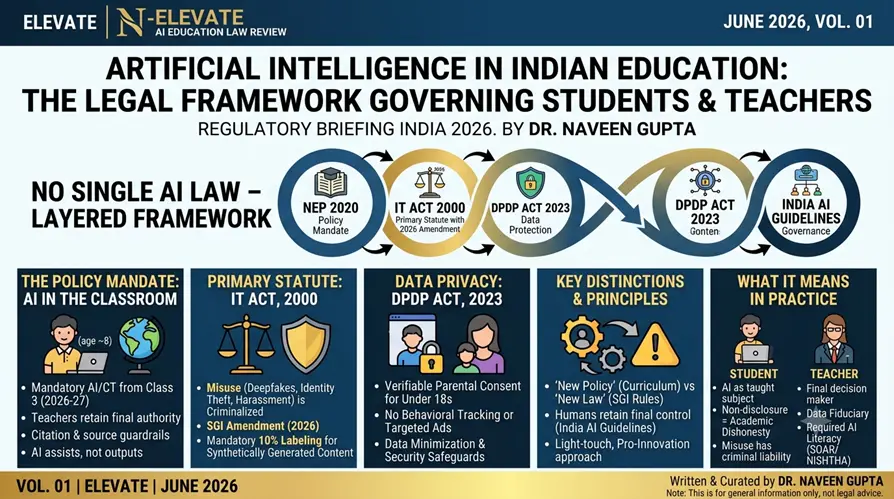
01 The short answer
As of mid-2026, there is no standalone “AI law” in India and no education-specific AI statute. The government has deliberately chosen a pro-innovation, “light-touch” path rather than a comprehensive code like the EU AI Act, taking the view that most AI-related risks can be addressed through existing laws read technology-neutrally.
For schools and universities, this means the rules that bind students and teachers come from three directions at once: (a) education policy that makes AI part of the curriculum, (b) the IT Act and the 2026 rules that criminalise misuse and regulate AI-generated content, and (c) data-protection law that governs how learner information is handled.
KEY DISTINCTION
“New law” vs “new policy.” The headline 2026 development for education — making AI a compulsory subject from Class 3 — is a curriculum mandate under NEP 2020, not a statute. The genuinely new binding legal instrument is the IT Rules amendment of February 2026 on AI-generated (“synthetically generated”) content, made under the IT Act.
02 The policy mandate: AI in the classroom
From the 2026–27 academic year, Artificial Intelligence and Computational Thinking become mandatory curriculum components from Class 3 onwards, rolling out for Classes 3–8 in 2026–27 and Classes 9–10 in 2027–28. This flows from the National Education Policy (NEP) 2020 and the National Curriculum Framework for School Education (NCF-SE) 2023, with the framework developed by a CBSE expert committee and reviewed by NCERT.
The framework places clear obligations on how AI is used in teaching:
• Teachers retain final authority over grading and feedback — AI may assist but must not make the final assessment decision.
• Guardrails for younger learners — built-in citation prompts, source cross-checks and teacher-controlled restrictions on certain outputs.
• Assistance vs. outsourcing — tasks should require visible reasoning (annotations, rough work, oral defence) that AI cannot convincingly simulate, drawing a line between legitimate help and academic dishonesty.
• Teacher capacity-building through national programmes such as NISHTHA and the SOAR (Skilling for AI Readiness) modules.
Separately, many universities have begun drafting their own AI-use policies defining acceptable assistance, disclosure norms and penalties for misuse — these are institutional rules, enforceable as part of academic regulations rather than national law.
03 The Information Technology Act, 2000 — the governing statute
The IT Act remains the backbone of digital governance and is the statute most likely to be invoked when AI is misused in an educational setting — for example, deepfakes of a classmate or teacher, impersonation, harassment, or data breaches. The relevant provisions:

04 The new 2026 rules on AI-generated content
The most significant new binding instrument is the IT (Intermediary Guidelines and Digital Media Ethics Code) Amendment Rules, notified by MeitY on 20 February 2026, made under the IT Act. It introduces a legal definition of “Synthetically Generated Information” (SGI) — content created or altered by AI that appears authentic — and imposes:
• Mandatory labelling. AI-generated content must carry a prominent disclosure covering at least 10% of the visual area, or the first 10% of an audio clip's duration.
• Platform due diligence. Intermediaries enabling SGI creation must verify and label such content; significant social-media intermediaries face traceability and consent-verification duties.
• Safe-harbour clarification. Good-faith removal of SGI is protected under Section 79.
For education, this directly targets the deepfake problem — manipulated images, voices and videos of students or teachers — and obliges platforms used in schools to label and act on AI-generated material.
05 Student & teacher data: the DPDP Act, 2023
The Digital Personal Data Protection Act, 2023 (with Rules notified in 2025, phasing in through 2027) governs how AI systems and ed-tech platforms handle personal data — highly consequential for a sector built on minors' information.


Beyond children's data, institutions acting as Data Fiduciaries must observe purpose limitation, data minimisation, security safeguards and breach notification, and honour learners' rights of access, correction and erasure — including where AI is used in automated decisions such as admissions or grading.
06 Guidance, not law: the India AI Governance Guidelines
In November 2025, MeitY released the India AI Governance Guidelines under the IndiaAI Mission. These are a foundational reference, not enforceable law. Built on seven guiding principles (“sutras”), they are notable for education because they insist that:
• Humans keep final control over AI systems “as far as possible” — reinforcing the teacher's role as ultimate decision-maker.
• AI systems are not “intermediaries” under the IT Act, leaving classification and liability to future deliberation.
• Existing laws suffice for now — the IT Act, DPDP Act and BNS are judged adequate, with targeted amendments rather than a new omnibus AI statute.
07 What it means in practice
For students
• AI is now a taught subject, but using it to complete assessed work without disclosure can breach institutional academic-integrity rules.
• Creating deepfakes or non-consensual manipulated images of peers or staff can attract criminal liability under IT Act §§ 66E, 67/67A/67B and the BNS.
• Students (and their guardians) hold data rights over information fed into AI ed-tech, with special protection for under-18s.
For teachers
• Final authority over grading and feedback must remain human — AI may assist, not decide.
• Teachers and institutions handling student data act as Data Fiduciaries and must meet DPDP consent, minimisation and security duties.
• Any AI-generated teaching material that is synthetic must be labelled per the 2026 rules.
• Teachers are expected to build AI literacy through NISHTHA/SOAR and to design tasks that surface genuine reasoning.
08 On the horizon
Two developments will reshape this picture:
• The Digital India Act (DIA) — a long-pending overhaul expected to replace the IT Act, introducing risk-based classification, algorithmic transparency and dedicated provisions for AI and deepfakes. Still in draft; public consultation anticipated through 2026.
• The Artificial Intelligence (Ethics & Accountability) Bill, 2025 — a Private Member's Bill introduced in the Lok Sabha in December 2025, proposing mandatory ethics reviews, bias audits and penalties up to ₹5 crore. Not enacted, but a signal of legislative direction.
Written & curated by
Dr. Naveen Gupta
National ICT Awardee & Delhi State Best Teacher Awardee · Educator · AI Trainer · Innovator · Leader
Note. This briefing summarises India's composite legal and policy framework on AI in education as of June 2026 and is for general information only — it is not legal advice. There is no single “AI in education” statute; the position is assembled from the IT Act, 2000 (and its February 2026 SGI amendment), the DPDP Act, 2023, the BNS, 2023, NEP 2020 / NCF-SE 2023 curriculum policy, and the non-binding India AI Governance Guidelines (November 2025). The law is evolving rapidly; verify against the current text and seek qualified counsel before relying on any provision.