
Limited practical knowledge regarding the environment, health, and life skills: Students are unaware of the plant species on school premises, their medicinal properties, and their significance in Indian mythology. Consequence: Traditional knowledge is eroding, and environmental awareness is declining. Unequal access to digital content: Educational activities and resources—such as e-content, motivational programs, the 'Nasha Mukt Bharat Abhiyan' (Drug-Free India Campaign), 'Ek Ped Maa Ke Naam' (A Tree in Mother's Name), 'Viksit Bharat Buildathon', 'Pariksha Pe Charcha', 'Samagra Shiksha Abhiyan', rainwater harvesting, award ceremonies, school documentaries, and information on Artificial Intelligence—do not reach students and teachers due to a lack of transparency. Limited educational resources: Information is not accessible to every student simultaneously or through uniform methods. Lack of acceptance of educational activities by both students and teachers. Lack of accountability among both students and teachers. This hinders the full implementation of the objectives of NEP 2020.
Proposed QR code-based solutions for the school:
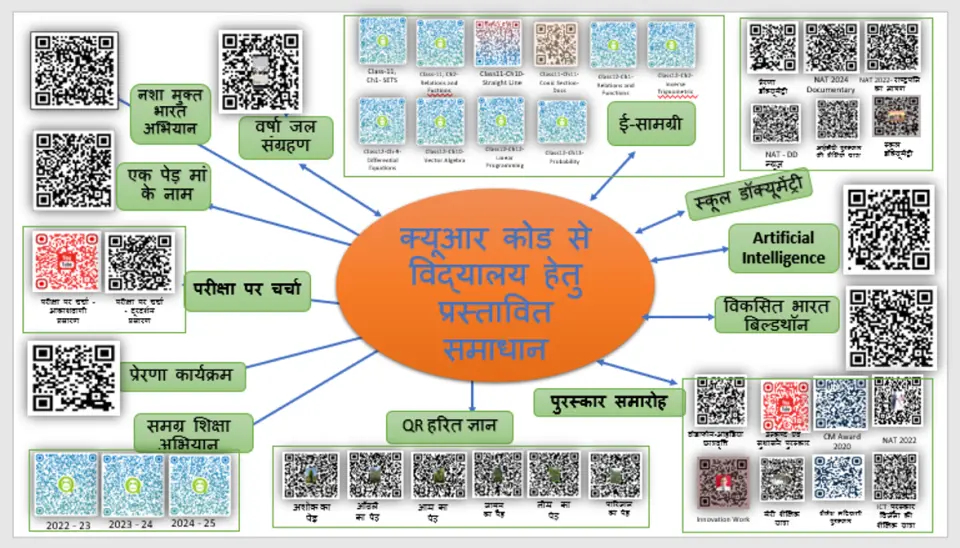
a- QR 'Harit Gyan' (Green Knowledge) – Indigenous identification of school plants: Our team created a "QR code-based plant information system." Each plant will feature a QR code; upon scanning it, students and parents can view details on their mobile phones, such as:
1- Plant Name: Local and scientific names.
2- Mythological Significance: Association with specific deities, legends, or cultural traditions.
3- Medicinal Properties: Ayurvedic uses and herbal benefits.
4- Environmental Role: Oxygen emission, shade provision, soil improvement, and biodiversity support.
5- Educational content curated via photos/video links. https://youtube.com/shorts/J6xAQf5E1nw?feature=share
b. QR: E-content – E-content has been prepared for each chapter of the curriculum, and the corresponding QR codes have been printed and displayed on the notice board. By scanning these, students and teachers can access notes for the relevant chapters to aid the teaching-learning process. https://forms.gle/WH5UY711kJaspcBq6
c. QR: Samagra Shiksha Abhiyan (Holistic Education Campaign)– Our team created a "QR code-based information system for the Samagra Shiksha Abhiyan." A QR code linked to the annual income and expenditure details will be provided; scanning it allows students and parents to view the financial breakdown on their mobile phones. This demonstrates transparency, acceptability, and accountability in the school's operations. https://docs.google.com/spreadsheets/d/1Rj6bYRALkSWJIz8kKhzkprDx_BGr6dM2_JOu7Id6oGM/edit?usp=sharing
d. QR: 'Ek Ped Maa Ke Naam' (A Tree in Mother's Name) –
a) Under Prime Minister Modi's 'Ek Ped Maa Ke Naam' initiative, the participation of 140 school students has been ensured in environmental activities.
b) Certificates received by all students through the online program have been compiled and displayed on the school notice board via a QR code. ...which can be viewed at any time by scanning it.
c) This demonstrates the development of digital literacy among students.
https://drive.google.com/file/d/1B5cHK17qpOSwCCiX-TpZDr22-I0yZcvL/view?usp=sharing
e. QR: 'Pariksha Pe Charcha' (Discussion on Exams) Program-
• Student participation in Prime Minister Shri Modi's 'Pariksha Pe Charcha' program has fostered the development of digital literacy.
• QR codes linking to the broadcasts of the school's 'Pariksha Pe Charcha' program—aired on Akashvani (All India Radio) and Doordarshan—have been displayed on the school notice board.
• These can be viewed at any time by scanning the QR code.
• This demonstrates the development of digital literacy among students. https://youtu.be/ijy7A7P6NLk?feature=shared
f. QR: 'Nasha Mukt Bharat Abhiyan' (Drug-Free India Campaign)-
• Under the 'Nasha Mukt Bharat Abhiyan', 37 students from the school participated via the website www.mygov.in, completed the online pledge and quiz program, and received certificates.
• The certificates of all participating students have been compiled and displayed on the school notice board via a QR code, which children can scan and view at any time.
• This demonstrates the development of digital literacy among students.
• This strengthens the moral development of students.
https://drive.google.com/file/d/1y2i4Rvx_PTYolgEUUb4mOAc-hBI9ej6u/view?usp=sharing
g. QR: Viksit Bharat Buildathon-
1- Under the 'Viksit Bharat Buildathon 2025' program, a group of 5 students, led by the school principal Shri K.C. Joshi, completed an innovative project, uploaded it to the website https://vbb.mic.gov.in/, and received certificates. 2- All certificates have been compiled and displayed on the school notice board via a QR code, allowing them to be viewed by scanning at any time.
3- This demonstrates the development of digital literacy within the school.
4- This innovative project is an effective initiative at the school level that brings the vision of NEP 2020 to fruition.
https://drive.google.com/file/d/1Bka_nsXn5JHy0D9h1NGmebG_0GGTAlJr/view?usp=drivesdk
h. QR: School Documentary-
• A documentary about our school has been produced by the Union Ministry of Education, Government of India.
• Additionally, our school has been featured in the documentaries for the 'Prerna' Program 2024 and the National Teachers' Award Program 2024.
• These school documentaries have been compiled and displayed on the school notice board via a QR code, which can be scanned and viewed using a mobile phone.
• This demonstrates the development of digital literacy within the school. https://fb.watch/fxuuHYDo5E/
Send feedback.
i. QR: Award Ceremony/Initiative –
1- Information regarding the school's various innovative achievements has been compiled and displayed on the school notice board via QR codes, which anyone can view by scanning with a mobile phone.
2- This showcases the school's development and fosters a positive attitude towards education within the community.
https://youtu.be/TpX2bndBU8Q?feature=shared
In this project, the school campus has been transformed into a QR code-based learning ecosystem, where students—
1- Access a digital compilation of educational materials.
2- Access information on the medicinal and mythological significance of plants.
3- Access content uploaded to Google Drive, YouTube, or the school website.
4- Create distinct QR codes for each subject or activity.
5- Display QR codes in classrooms, the garden, and on notice boards.
6- Train students and teachers on using the system by dedicating one day a week to scanning and exploring the information via QR codes.
Students will gain a better understanding of local biodiversity, Ayurveda, and traditions. The school will become a "Living Botanical Museum." The rural community will be inspired to recognize that the importance of plants is not merely environmental but also cultural. This model can be adopted by other schools as well. Using QR codes offers a modern and effective approach to school activities. It promotes transparency, equity, timeliness, adherence to rules, acceptance, and accountability. Moves the school towards a paperless environment. Represents a step towards the future of education.
The information was too lengthy—initial QR pages contained overly detailed descriptions that were time-consuming to read. Some QR codes were getting damaged by sunlight or rain; there were issues with print quality and durability. There were errors in the names of some plants. Technical challenges: Students may not always have access to smartphones. QR codes may require internet access, which not every student might have.
Improvements-
1. Concise and engaging information prepared — details for each plant limited to 4 sections:
a- Common name and scientific name
b- Mythological significance
c- Medicinal uses
d- Environmental importance
2. Laminated QR cards installed to ensure protection against rain and sunlight.
3. Students' learning progress can be monitored and enhanced through QR codes.
4- School tablets / shared mobile phones.
5- Facilitating communication and gathering student feedback via QR codes.
6- Digital literacy training.
Resources-
Technical- QR code generator, smartphone, internet, printer
Physical- Plant boards/labels, lamination sheets
Human Resources- 5–7 students, science teacher, IT teacher
Supporting sources- Timetable, notice board, teacher attendance records, assignments, and exam results.